
From answering questions to doing the work: what a coding tool tells us about AI’s next move in retail
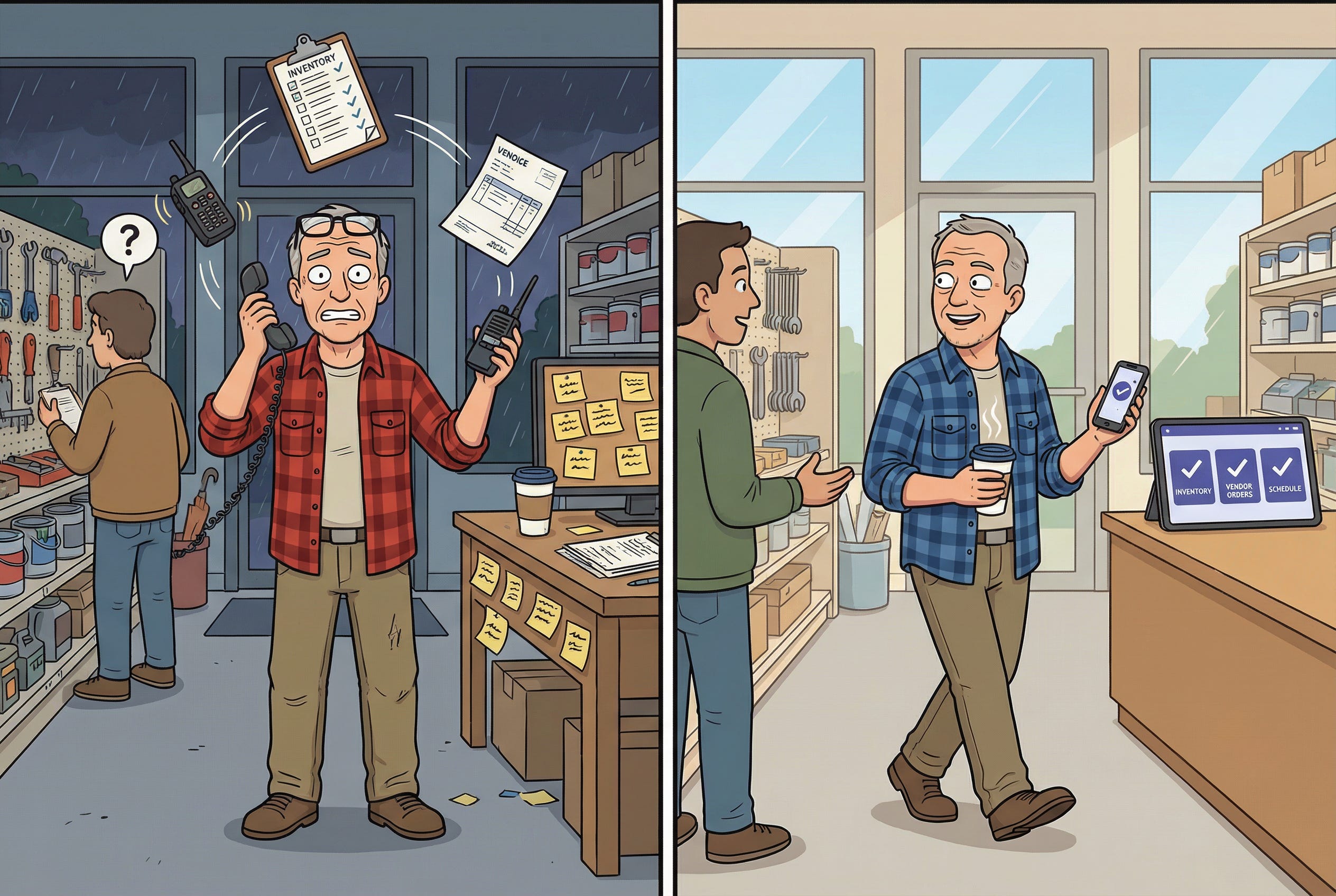
It’s Tuesday morning. You own five hardware stores. Before you’ve finished your coffee, you’ve reviewed stock levels at three locations, taken two vendor calls, texted a manager about weekend staffing, and started comparing prices on a bulk fastener order.
None of these decisions are hard. You’ve been doing this for 30 years. The volume is what kills you. Two hundred small decisions a day, and each one needs you — or at least, each one has always needed you.
Something just happened in the software world that’s about to change that math.
A coding tool did something new
Until recently, every AI tool worked the same way. You ask a question. It gives you an answer. You do the work.
Earlier this year, a company called Anthropic shipped something that broke that pattern. It’s called Claude Code, and it’s a tool for software developers. But what it does matters far beyond software.
Claude Code doesn’t just answer questions about code. It reads an entire codebase — thousands of files — then plans what needs to change, makes the edits, tests whether they work, and fixes its own mistakes. It does this for hours without a human touching the keyboard. One company reported their engineering teams working 2 to 10 times faster with it.
That’s not “AI-assisted work.” That’s AI doing the work.
The difference sounds subtle. It isn’t. It’s the difference between a calculator and an accountant.
The pattern that matters
If you’ve been in business long enough, you’ve seen every technology follow the same arc.
First, it answers questions. Search engines answered questions. Early AI chatbots answered questions. You ask, it tells, you act.
Then, it assists with tasks. Google Maps doesn’t just tell you where to go — it gives you turn-by-turn directions. AI started drafting emails, suggesting inventory reorders, flagging anomalies.
Then — and this is the jump that just happened — it executes independently. It doesn’t suggest a route. It drives the car.
Gartner predicts that 40% of enterprise applications will include task-specific AI agents by the end of this year, up from under 5% last year. Lowe’s has already deployed an AI assistant to all associates across 1,700+ stores. By 2028, Gartner expects AI agents to handle at least 15% of everyday business decisions autonomously.
The industry calls this “agentic AI.” In plain English: AI that does the work, not just talks about it.
Why this hits independent retailers differently
When Lowe’s deploys AI, they have a technology department, a budget, and a rollout plan. They have people whose entire job is figuring this out.
You have yourself and a few managers. You’re the buyer, the HR department, the pricing analyst, and the operations manager. You’re not ignoring AI because you’re behind — you’re ignoring it because you’re running a business.
Here’s the thing: that’s exactly why agentic AI matters more for you than for Lowe’s.
AI that answers questions is nice. AI that does the work is transformational for someone who’s already doing six jobs. Small business AI adoption surged 41% last year — jumping from 39% to 55% — and most of that growth is coming from owners who realized AI handles the tasks they never had staff for in the first place.
The economics are starting to show. A 2025 Capgemini survey of 1,500 executives found companies averaging a 1.7x return on AI investments — and 62% increased their AI budgets year over year. They’re not spending more because it’s trendy. They’re spending more because it’s working. For a five-store operation spending a few hundred dollars a month on AI tools, that kind of return is the equivalent of a reliable part-time employee — one who never calls in sick.
What “agent” looks like in a store
This isn’t science fiction. Here’s what retail AI agents will look like within the next couple of years:
An inventory agent checks stock across your five locations every night. It spots that store #3 is running low on PVC fittings and store #1 has excess. It evaluates whether to transfer between stores or reorder from a vendor — and it does it, within the rules you’ve set. You wake up to a summary, not a crisis.
A pricing agent monitors competitor pricing on your top 200 SKUs. When the big-box down the street drops their price on a key item, the agent adjusts your price within the margin range you’ve defined. You set the strategy. It handles the surveillance and execution.
A customer knowledge agent recognizes when a returning contractor walks in. It pulls their purchase history, knows they’re working on a framing project based on recent buys, and prepares a quote for the materials they’re likely to need. Your associate gets a head start instead of starting from scratch.
Research on multi-agent systems — where specialized agents work together — shows 45% faster resolution times and significantly more accurate outcomes compared to single-tool approaches. And companies that adopt early are seeing substantially higher returns than those that wait.
The reframe
The wrong question: “How do I compete with big-box technology budgets?”
The right question: “What decisions am I making 50 times a week that don’t actually need me?”
Claude Code proved something important: AI can now handle multi-step work that requires judgment, not just recall. It plans, executes, evaluates, and adjusts — the same loop you run through 200 times a day on vendor orders, staffing decisions, price checks, and inventory calls.
The gap between that capability existing in software and arriving in your store is closing fast. Not because retailers are building AI — but because the AI companies are building for retailers.
The store owners who thrive in the next five years won’t be the ones who become AI experts. They’ll be the ones who get honest about which of their 200 daily decisions are real judgment calls — the kind that require 30 years of hardware retail experience — and which ones just feel that way.
Back to Tuesday morning
Same owner. Same five stores. Same coffee.
The vendor calls, the stock levels, the staffing texts, the price comparisons. Which of those tasks needed three decades of expertise? And which ones just needed someone reliable to follow a clear process?
That distinction is about to become the most valuable thing an independent retailer can understand.