
You can’t train 25,000 products. But you can make them searchable.
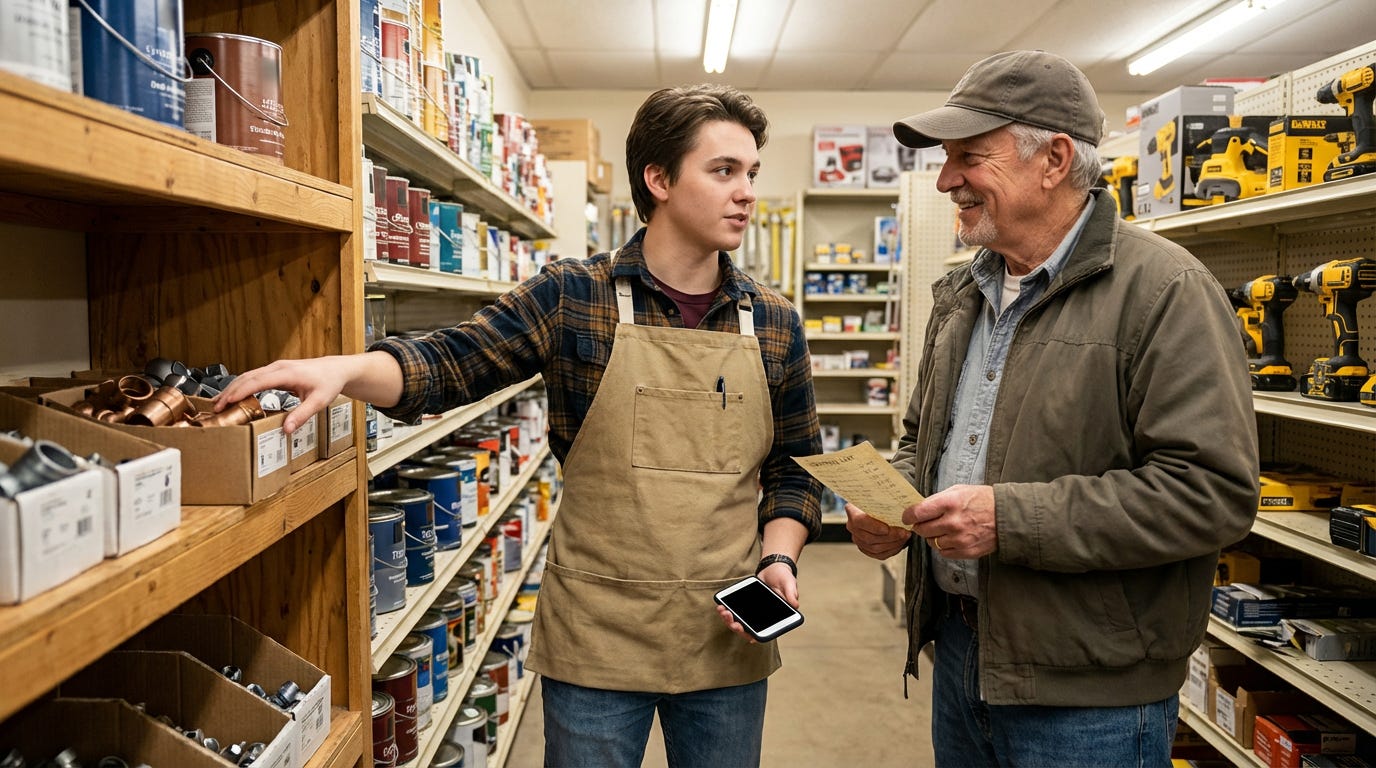
A customer walks in with a broken toilet flapper. They don’t know what it’s called—they describe it as “the rubber thing at the bottom of the tank.” Your new hire has been on the floor for two weeks.
What happens next?
At a big-box store, the answer is easy: point them to aisle 24 and wish them luck. But at an independent hardware store, customers expect more. They expect someone who can identify the part, recommend the right replacement, and maybe even explain how to install it.
That’s the competitive advantage of independent hardware stores. It’s also their biggest vulnerability.
The knowledge problem
Hardware stores carry around 25,000 products. A veteran associate doesn’t know all of them—but they know which plumbing fittings are interchangeable, what questions to ask when someone needs electrical wire, and which paint will actually stick to a deck.
This knowledge comes from years of answering customer questions, making mistakes, observing colleagues, and accumulating hands-on experience. One hardware store owner described it as “thousands of hours learning in classes and on the job.”
Thousands of hours. Not weeks. Not months. Years.
And here’s the problem: half of all hourly retail workers leave their job within the first 120 days. By the time someone starts getting good, they’re often already gone.
Why traditional training fails
The standard approach to new hire training looks something like this:
A few days of orientation
Shadow a veteran employee
Learn the register system
Figure out the rest on the job
In fact, 32% of retail employees report receiving no formal training at all. The assumption is they’ll figure it out on the job.
This works fine for jobs where the knowledge set is small. But you can’t teach 25,000 products. You can only hope new hires pick things up over time—and hope they stick around long enough to become useful.
Most don’t. Every employee who leaves costs you recruiting, hiring, and training all over again—typically 50-200% of their annual salary. For a store with 10 employees turning over half of them each year, that’s the equivalent of 2-5 full salaries spent just replacing people. And that doesn’t count the harder-to-measure cost: customers who leave frustrated because the new person on the floor couldn’t help them.
The experience gap
Big-box stores solved this problem by lowering expectations. Home Depot and Lowe’s are self-service by design. You grab what you need, maybe use a kiosk, and check out. If you need help, good luck finding someone who knows more than what’s on the label.
Independent hardware stores can’t compete on that model. Their value proposition is expertise—the helpful employee who asks the right questions and finds the right solution.
But expertise takes years to develop. And with 50% turnover in the first four months, most employees never get there.
What if knowledge was accessible on day one?
The equation changes when you stop thinking about training as knowledge transfer and start thinking about it as knowledge access.
A new hire doesn’t need to memorize 25,000 products. They need a way to find the right answer when a customer asks. They need to know what’s in stock, where it’s located, and what it’s used for—right now, on the sales floor.
That’s what AI assistants like FastQuery do. Instead of years of accumulated knowledge in someone’s head, you have instant access to product information, inventory, and problem-solving context.
As Eric Hassett, owner of Hassett Hardware, put it: “FastQuery puts all of the knowledge an associate would take thousands of hours learning in the palm of their hand on day one. A first-day associate can help customers like a veteran.”
The bottom line
Independent hardware stores compete on expertise. But expertise has traditionally required years to develop—time that most employees don’t stick around for.
The data backs this up: companies with strong onboarding programs improve new hire retention by 82%. But “onboarding” in hardware retail isn’t about paperwork and orientation videos—it’s about knowledge access.
The stores that figure out how to give new hires instant access to knowledge will have a structural advantage. Their employees will be confident on day one. Their customers will get the expert service they came for. And when someone inevitably leaves, the knowledge doesn’t walk out the door with them.
You can’t train 25,000 products. But you can make them searchable.